Blog

  • Adverse Childhood Experiences Study

    Adverse Childhood Experiences Study

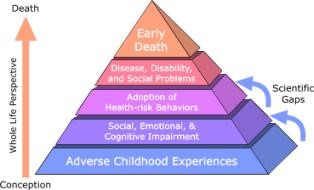
    ACE Pyramid ImageThe Adverse Childhood Experiences (ACE) Study is one of the largest investigations ever conducted to assess associations between childhood maltreatment and later-life health and well-being. The study is a collaboration between the Centers for Disease Control and Prevention and Kaiser Permanente’s Health Appraisal Clinic in San Diego[i].

    More than 17,000 Health Maintenance Organization (HMO) members who underwent a comprehensive physical examination were also asked to provide detailed information about their childhood experience of abuse, neglect, and family dysfunction. The initial phase of the ACE Study was conducted at Kaiser Permanente from 1995 to 1997. More than 17,000 participants completed a standardized physical examination and an ACE survey. No further participants will be enrolled, but the study group is tracking the medical status of the baseline participants.

    The ACE Study findings suggest that certain experiences are major risk factors for the leading causes of illness, including addiction, leading to poor quality of life,  as well as death. It is critical to understand how some of the worst health and social problems in our nation can arise as a consequence of adverse childhood experiences. Realizing these connections is likely to improve efforts towards prevention and recovery.

    Compared to persons with no adverse childhood experiences, the risk of heavy drinking, self-reported alcoholism, and marrying an alcoholic were increased twofold to fourfold by the presence of multiple adverse childhood experiences, regardless of parental alcoholism. Subsequent reviews of the study found that the prevention of adverse childhood experiences and treatment of persons affected by adverse childhood experiences may reduce the occurrence of adult alcohol problems[ii]. Adverse childhood experiences seem to account for one-half to two-thirds of serious problems with drug misuse by adolescents[iii].

    Children in alcoholic households are more likely to have Adverse Childhood Experiences. The risk of alcoholism and depression in adulthood increases as the number of reported adverse experiences increases. Depression among adult children of alcoholics appears to be largely, if not solely, due to the greater likelihood of having had Adverse Childhood Experiences in a home with alcohol-abusing parents[iv].

    Clearly, children that have experienced emotional, physical or sexual abuse in their early childhood are at a severe risk for addiction. To show you how small an amount of abuse is needed to tip the scales of raising a healthy child or an at risk child, read the last series of questions from the ACE Questionnaire, which are highly revealing questions.

    1. Did a parent or other adult in the household swear at you, insult you, put you down or humiliate you?
    2. Did a parent or other adult in the household push, grab, slap, or throw something at you?
    3. Did you often or very often feel that no one in your family looked out for each other, no one felt close to or supported each other?[v]

    This survey gives you an idea how delicate and impressionable a young child is.

    For a sample of the ACE Questionnaire, click on this link: http://www.cdc.gov/violenceprevention/acestudy/questionnaires.html


    References used in this blog:

    [i] [i]The Relationship of Adult Health Status to Childhood Abuse and Household Dysfunction“, published in the American Journal of Preventive Medicine in 1998, Volume 14, pages 245–258.

    And

    http://www.cdc.gov/violenceprevention/acestudy/index.html

    [ii] Addict Behav. 2002 Sep-Oct;27(5):713-25.

    Adverse childhood experiences and personal alcohol abuse as an adult.

    Dube SR1, Anda RF, Felitti VJ, Edwards VJ, Croft JB.

    [iii] Pediatrics. 2003 Mar;111(3):564-72.

    Childhood abuse, neglect, and household dysfunction and the risk of illicit drug use: the adverse childhood experiences study.

    Dube SR1, Felitti VJ, Dong M, Chapman DP, Giles WH, Anda RF.

    [iv] Psychiatr Serv. 2002 Aug;53(8):1001-9.

    Adverse childhood experiences, alcoholic parents, and later risk of alcoholism and depression.

    Anda RF1, Whitfield CL, Felitti VJ, Chapman D, Edwards VJ, Dube SR, Williamson DF.

    [v] Center for Disease Control web site

    http://www.cdc.gov/violenceprevention/acestudy/questionnaires.html

    Share
  • Danny Trejo’s Path from Drug Abuse to Prison, Sobriety to Acting Fame

    melissa-new-post
    Melissa Killeen

    Iconic Hollywood “tough guy” Danny Trejo has lived an incredible life, and he’s been sober for 46 years of it. A new AARP documentary, produced by Washington, D.C.-based filmmaker TJ Cooney, tells the story of how the Desperado actor transitioned from a life of substance abuse and violence to becoming a drug counselor, Hollywood actor, and mentor for young people.

    “I thought that drugs were my answer. As long as I stayed loaded, I’m okay,” recalls Trejo in a clip from the film, released exclusively to The Fix. “But life would turn into chaos.”

    As a teen, Trejo was in-and-out of juvie and prison, where he started boxing. In his mid-20s, he was released from prison and made a decision to get sober. “I dedicated my life to helping other people,” he says.

    After beginning a career as a drug counselor, Trejo ended up on a Hollywood movie set while helping one of his clients, who turned out to be an actor. He was hired as an on-set boxing coach, and was ultimately cast as an extra in the film. The role jumpstarted his acting career, and he has since appeared in up to five movies a year alongside actors like George Clooney and Robert De Niro.

    “Everything good that has happened to me has happened as a direct result of helping someone else,” he says.

    Trejo continues to mentor young people and speaks at college campuses across the country. “My passion is talking to young people who want to stay out of trouble,” he says. “My message is: staying away from drugs and alcohol, and education, is the key to anything you want to do.”

    He uses his notoriety to get young people to listen, and hopes his own story will inspire others to follow in his footsteps. “I love that responsibility of being able to help people do right,” he says. “I was an addict and alcoholic and I know that road. That road leads to death, institutions or insanity. I’ve been sober for 46 years and have had a great, great life.”

    This article appeared on 7/30/2015 at thefix.com and was written by May Wilkerson. The video is courtesy of the AARP.

    Editor’s note: I was introduced to Danny Trejo by researching Bob Timmins’ story. Bob is recognized as the first recovery coach. When Bob was in San Quentin, he was friends with Danny. Upon Bob’s release Bob went to Danny’s house, expecting to start where he had left off, robbing and drugging. He knocked on Danny’s door, Danny gave him a room, fed him a meal and took him to his first 12-step meeting. Danny introduced Bob to his first sponsor, a sponsor/sponsee relationship that lasted over twenty years. Danny was pivotal in saving Bob’s life.


    Share
  • I will never leave you – I am a love addict

    This post is part two of a topic that was posted last week.

    melissa-new-post
    Melissa Killeen

    “I will never leave you.”

    “You are such a brilliant woman.”

    “I want to give you so much love.”

    A woman can give me what I never received. Their arms around me, their caring embrace, the love that I never received because I was an orphan. I will never leave them. They will never leave me. I have an abject fear of abandonment. I think they fear abandonment, too.

    They will support me, just like my sponsor in Germany and I will support them, I will fix their house, attend to the lawn, tune up the car. I will be theirs, forever. I want to be in love with a woman. My mind slips into fantasy as I troll the pages of Linked In and Facebook. I want to have the emotional attachment with a woman, the connection, and the bond. I want that maternal bond.

    I know it is silly to even mention marriage one week into an on-line conversation, but I have to be honest, I really want to marry these women. I want to be attached to them. Eventually, I will have a sexual interlude, over the phone,  but not often. I am not as interested in the sexual acts, it is the fantasy that I am so stimulated by. I like to be under a women’s control, I feel safe. She calls me at all times of the day. We talk for hours. I tell her the things I really want to hear. Texting is my favorite. My texts responses are pre-programmed in my cell.

    “I love you.”

    “Good night my sweetheart, I will dream about you.”

    “When we are together I will never let you go.”

    She sometimes needs convincing that she loves me too, so I weave in my business story into this ritual of seduction. She loves my accent. I tell her all about my worldly adventures and business dealings. That I have just had a great business proposition handed to me. My best friend and business partner pulled out of because he and his wife are divorcing. His lawyer advised him not to make a lot of money right now, because his wife will claim half of it. Seven days after we meet on-line, I send out the pitch, do you want to invest $30K? Can you let me borrow $20K? I mix it up, depending on how much my lover (yes we call each other lover, sweetheart, and dearest by now) can liquidate from her IRA or CD’s.

    Ten days into a relationship I am either rich, or I find a new lover.

    But I am also devastated. Why did she say no? I want to call her every minute of the day. I look at my cell waiting for her text to arrive. I can’t sleep. I think I must try to convince her to come back to me. Sometimes I do. If she comes back to me, I have to ask her for money again. Usually in three days I text her again.

    If I receive money from her, she is elevated to queen status in my life. But often times she has expectations I cannot fulfill. I am her lover, her fantasy and she wants to meet me. She wants us to meet at a four star hotel for a tryst. Maybe spend a week on a cruise ship. I can’t leave my other women, while I cruise the Caribbean. So I have to distance myself. Eventually, I know she will abandon me, they all do. So I abandon her first.

    But it breaks my heart.

    It takes me weeks to recover.

    So I find another.

    I am a love addict.


    Share