Author: Melissa Killeen

  • Child Pornography – Part One

    Melissa Killeen
    Melissa Killeen

    Possession of child pornography is a felony under federal law, as well as every state. Because I am a recovery coach, I know some offenders, and I had some questions. I wanted to know more about these viewers of child pornography. Are they all potential hands-on offenders? Is this a victimless crime? What is the demographic of the users of underage pornography? I found there were some staggering statistics about child pornography. That billions of dollars are generated annually by child porn. The volume of pornography shared for free is incredible. That one image is all that is required to be convicted and eventually spending 15 years on probation under Megan’s Law. I wondered what were the costs to maintain the non-violent offenders of Megan’s Law, for life? This blog post, as well as others that follow, will explore these issues.

    How is child pornography viewed?

    Peer-to-peer (P2P) computer platforms are the most likely portal to view underage or child pornography. These are sites that share files for free. There are also for-profit pornography sites, which charge viewers a monthly membership fee. The for-profit pornography sites do list child porn sites, but are well hidden, because to do so is illegal. A person really has to dig and search diligently to find these child porn sites. Then there is the Dark Web.

    How does a P2P Network work?

    Peer-to-Peer Networks or file sharing networks are vast global systems that can be located anywhere in the world. P2P networks are used by millions of people in order to acquire, for free, popular music, current television shows, movies, electronic books, and other digital material. The software allows users to log onto any P2P network and download files from other P2P network users.

    Limewire, Gnutella, or other file sharing programs are downloaded to your computer in order for you to view files. Users create copies of movies, book or photographs, and place them into folders that are accessible to other peers. Users search by using keywords, just like you search on Google, to find these folders. Type in what you are looking for, and these keywords are broadcast to the network of participating peers and again, just like Google, files appear below the search box.

    There are several reasons P2P networks are particularly attractive to child-pornography traffickers. First, child pornography on P2P networks is free. Any person with access to the Internet can connect to a P2P network. P2P networks do not make use of servers, which means users can transmit illegal material without oversight from an online service provider like Google, EBay or NetFlicks. P2P networks are an anonymous way used to view, buy or sell anything online. The Dark Web, however, is more anonymous.

    What is the Dark Web?

    The “Dark Web” is an encrypted network that exists between Tor servers and their clients. These Tor servers are set up to be anonymous. After downloading a Tor browser bundle, clients can search the Dark Web, a supermarket of illegal activity, for drugs, weapons, murder for hire or pornography. For a porn addict, the Dark Web has anything that addict could want. Porn mixed with anonymous high-speed Internet is a lethal mix.

    Next week, I will discuss in more detail the demographic of the average child-pornography viewer. If you know of anyone producing, promoting or possessing child pornography, please report them through the National Center for Missing & Exploited Children’s CyberTipline: 1 (800) 843-5678

    Share
  • Ten Ways of Improving Your Chances of Keeping that New Year’s Resolution

    Ten Ways of Improving Your Chances of Keeping that New Year’s Resolution

    calvin-hobbes-new-year-resolution1Make a list and think it through

    It’s that time and everyone is thinking of New Year’s Resolutions. You’re itching to get rid of that bad habit right now, but you want a way of improving your chances of keeping your New Year’s Resolution, so consider this: think it through. I know you have heard that AA saying “Baby Steps” before…but sticking to a habit change is not trying to be perfect right out of the gate. So before you start trying to change a habit, consider thinking about it thoroughly for a month or two. First, list every reason you want to stop, figuring out what triggers or cues you react to, what routine you fall into as a result of that trigger and experiment with the types of rewards you are looking for from that habit. Write down and record every time you catch yourself doing the habit, and soon a pattern will appear. Maybe checking out a few twelve step programs or a therapy group can give you an idea of outside support options. You will be better prepared to conquer the habit after processing it during the next few weeks.

    2.  Identify your triggers

    By doing this review you will see you do the same behaviors, in the same place, at the same time. If at 3:00, you go on a smoke break in your car, the time and the car itself can become a trigger (or cues as Charles Duhigg author of The Power of Habit calls them). These actions can become a cue to start a habit —sometimes these cues are very subtle to notice. As AA says “Avoid People, Places and Things.” Identify and understand your triggers. These triggers fall into one of the following five categories:

    • Location, a bar, your ex-girlfriend’s neighborhood, a bakery
    • Time, 3:00, happy hour, visiting family
    • Emotional State, Hungry, angry, lonely or tired
    • Other People, the ex, your Mom, Dad or that annoying co-worker
    • An immediately preceding action, or what happened just before you picked up that joint? An argument with your spouse? Anticipating that your boss will ream your butt at work this morning for being late? Packing the car to see the folks for the holidays?

    3.  Delayed Gratification and Contingency Management

    There are some other simple psychological tricks you can employ as well, such as delayed gratification and contingency management. The 20-Second Rule is an example of delayed gratification: Make bad habits take 20 seconds longer to start. For example, move junk food to the back of the pantry, or leave the credit cards at home so you don’t over spend on lunch. A program sister suggests a Rule of Five, delaying the behavior until you have 5 glasses of water, or walk for 5 minutes or call five 12 step program people. Consider rewarding yourself for not relapsing, it’s called contingency management. Suggest this to yourself: if I don’t act out for 60 days, I can lead the Sunday night 12 step meeting or if I don’t drink now, later tonight, my wife and I can be intimate, or if I don’t use this week my IOP counselor will give me a free lunch coupon for the Olive Garden.

    4.  Reframe that habit thought

    Even if we hate the habit we’re doing, like smoking or over eating, we tend to continue doing it because it provides us with some sort of satisfaction or psychological reward. Catch yourself thinking any positive thoughts or feelings about your bad habits (like: if I have a drink, I will not feel so nervous around my in-laws) and reframe these thoughts to remind you of the negative aspects of your habits. Maybe think this thought instead, “One drink is too many and a thousand drinks is not enough.” That is reframing the habit thought.

    5.  Willpower is in limited supply

    Research has shown that we don’t have unlimited willpower (it didn’t take scholarly research to confirm this for you!) The truth is we’re constantly exercising willpower and self-control. The problem is that willpower is like a muscle, capable of fatigue and a muscle can’t be flexed forever. Researchers placed some study participants in situations in which they had to practice self-control—like not eating chocolate-chip cookies in front of them. While another group could eat as many cookies as they wanted. Then both groups were given a second test that required self-control.

    The results? The group that had to resist the cookies did not perform as well on the second task. The group that was allowed to eat as many cookies they wanted, excelled at this second self-control test. The conclusion was that those who had to exert more willpower in the first task exhausted their willpower strength, and were unable to exert the self-control needed for the second task.

    Just place yourself in a similar situation, think of you controlling yourself from strangling your self-absorbed-narcissistic colleague during a staff meeting, then around to 3:00, a typical smoke break time for you, you are triggered. You want to not smoke, but low and behold, a cigarette seems like just the reward you need.

    6.  Make a plan for relapses

    Chances are you’re going to have bad days. Setbacks are normal and we should expect them. Have a plan to get back on track. Recovery coaches call this a relapse prevention plan (click here to link to Mary Ellen Copeland’s WRAP Plan). Coaches have their clients write a relapse prevention plan directly after a slip as a way to understand what happened and how to avoid it next time.

    7.  Harm Reduction Option

    Every recovery coach anticipates a relapse, they acknowledge it will happen and attach no shame or guilt to a slip. Often, choosing an action based on Harm Reduction, (which is most often recognized as distributing clean needles to intravenous drug users to reduce HIV infection) is a good alternative. Some Harm Reduction ideas are: smoke a cigarette instead of a blasting a whole stick, limit yourself to buying a lottery ticket instead of logging on to a gambling web site or eat a cup of fruit yogurt instead of a chocolate chip cookie.

    8.  Change takes a village

    With making a resolution to change, don’t attach it to the ever failing New Year’s Resolution. Attach it to a positive change within you. Let people know about it. Ask for help, even if it is a nagging wife or over- bearing parent. Better yet, join a 12 step group. Research shows change happens when you have support from others.

    9.  Make a Plan

    Once you have figured out your ‘habit loop’, your cues/triggers, the routine you use, and the reward you expect, you can begin to shift your behavior. All you need is a plan. Open your-self up for improved, healthier routines; such as meditation, an afternoon walk, a talk with a co-worker or new way to drive home. These will become very good sources of generating your rewards and within 30, 60 or 90 days it will become a habit. Just give it time and

    10.  Succeed keeping your New Year’s Resolution! Don’t give up!


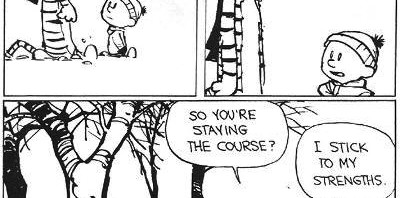
    Special thanks to Charles Duhigg author of The Power of Habit for supplying all of this excellent information on changing a habit And Calvin and Hobbes for making fun of it!

    Share
  • Believe Change is Possible

    Believe Change is Possible

    Melissa Killeen
    Melissa Killeen

    As a recovery coach, I work with people trying to change a habit. We work on finding different ways of responding to a trigger. For some seeking recovery, they want to find an easier, softer way. Others think willpower is all they need to get sober. But that doesn’t always work. As Charles Duhigg describes in his book, the Power of Habit, for a habit to be changed, people must believe change is possible.

    Where does this belief come from? Habit change can emerge from a tragedy or from some kind of adversity. Many addictions have been successfully abandoned when an individual hits bottom and finally seeks treatment. Many people give up smoking after a diagnosis of heart disease or when a family member is being treated for lung cancer.

    A Harvard study in 1994 examined people that had radically changed their lives. Some had experienced the death of a loved one, divorce or life-threatening illness. Others radically changed their life from observing a friend experience a disaster. Tragedy plays an important part of having an impact on one’s life. But equal to tragedy facilitating change, the same amount of people made change happen in their life because they were surrounded by supportive friends that encouraged change. The Harvard study sites a woman that changed the direction her life when she took one psychology course at a local college and found a group of like-minded individuals. Another man came out of his introverted shell when he joined an acting group. So for change to happen for many, it didn’t take a life shattering event, it simply took a community of believers.

    “Change occurs among people”

    Todd Heatherton, Dartmouth College Lincoln Filene Professor

    A community of non-smokers talk about how great it feels like to be a non-smoker. How nice it is not to have your hair smell like an ashtray. Your spouse commented on how fresh his clothes smell, now that you have stopped smoking. And co-workers admire you for having the strength to stop smoking. These like-minded people can also resolve some negative feelings, as well. Such as what to do after a meal, when the habit of lighting up a Marlboro is the most strong. Or how to refrain from smoking in your car. These friends are there for you to call, text or email whenever the urge to smoke becomes unbearable. Support from a community and their confidence in you, bolsters the strength you need to believe you will not pick up a cigarette.

    For habits to change permanently, people must believe change is possible. This same process makes any mutual support group very effective – the power of a group to teach individuals that they can believe it is possible to change. This belief happens when people come together to help one another to change. Whether the group is Nicotine Anonymous, a breast cancer support group or massive amounts of volunteers descending on New Orleans, post Katrina, to re-build the city to it’s former glory.

    Change is easier when it occurs within a community.

    Share